Safety barriers are passive protective systems that save lives — but only when they are in the right condition, correctly installed, and compliant with current standards. For local councils and road authorities managing hundreds or thousands of kilometres of road network, knowing the condition of your barrier assets is both a safety obligation and a legal one.
RSA | Road Safety Audits delivers specialist condition assessments of safety barrier systems for councils and road authorities across Australia. Our assessments cover W-beam guardrail, wire rope safety barriers, concrete barriers, bridge rails, and energy-absorbing terminals — evaluated against AS/NZS 3845, AASHTO MASH, and applicable state road authority requirements.
With over 30 years of road safety expertise and direct involvement in barrier design, installation standards, and safe system assessments on Australia’s largest infrastructure projects, RSA brings a level of specialist knowledge to barrier condition assessments that general civil contractors cannot match.
What Is a Safety Barrier Condition Assessment?
A safety barrier condition assessment is a systematic inspection of roadside and median barrier systems to evaluate their physical condition, installation compliance, and performance against current standards. The assessment identifies defects, damage, non-compliant installations, and end-of-service-life assets — and provides a prioritised scope of rectification works to bring the network back to a safe and compliant condition.
Barrier assessments go beyond a visual inspection. A thorough assessment considers whether the right barrier type has been installed for the hazard and speed environment, whether deflection clearances are adequate, whether terminals and transitions meet current crashworthiness requirements, and whether the system as installed matches the performance criteria of its tested and certified design.
RSA’s barrier condition assessments produce an itemised asset register with condition ratings, photographic evidence, GPS coordinates, and a clear scope of works — giving road managers the documentation they need for maintenance planning, budget submissions, and duty-of-care compliance.
Why Road Authorities Need Regular Barrier Assessments
Safety barriers deteriorate over time through vehicle impacts, corrosion, ground movement, and vegetation encroachment. A barrier that has sustained even a minor impact may no longer perform to its tested specification — and in a subsequent crash, that failure can be fatal. Regular condition assessments allow road managers to identify compromised assets before they fail in service.
Beyond physical deterioration, barrier standards have evolved significantly. Many barrier installations across Australian road networks were designed and installed under older standards — some pre-dating AS/NZS 3845 or AASHTO MASH — and no longer meet current performance requirements. A condition assessment identifies these legacy installations and quantifies the compliance gap, enabling a structured upgrade program.
There is also a duty-of-care dimension. Road authorities and councils that manage public roads have a legal obligation to maintain those roads in a reasonably safe condition. Documented barrier condition assessments demonstrate that the road manager has proactively identified risks and is taking steps to address them — a critical consideration in the event of a crash and subsequent legal proceedings. RSA’s senior team includes expert legal witnesses who understand exactly what level of documentation satisfies this standard.
Barrier condition assessments also support funding submissions. State and federal Black Spot Program applications, Roads to Recovery submissions, and internal capital works budgets all benefit from a credible, independently prepared assessment of the network’s barrier condition and the cost of rectification.
Types of Barrier Systems We Assess
W-Beam Guardrail
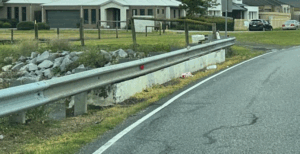
The most common barrier type on Australian roads, W-beam (or Armco) guardrail is assessed for post condition and spacing, rail section continuity and deformation, connection hardware, terminal types and condition, and installation geometry including deflection clearance and offset from hazard. Many existing W-beam installations use older terminal types — such as blunt ends or ET-2000 style terminals — that do not meet current MASH TL-2 or TL-3 requirements and present a significant risk to errant vehicles.
Wire Rope Safety Barriers
Wire rope barriers require assessment of rope tension, post condition and spacing, anchor assembly integrity, splice locations, and clearance to fixed hazards. Tension loss — whether through post damage, anchor deterioration, or maintenance omission — significantly reduces the barrier’s ability to redirect vehicles and prevent crossover crashes on divided roads.
Concrete Safety Barriers
Precast and cast-in-place concrete barriers are assessed for cracking, spalling, joint integrity, connection to bridge decks and transitions, and deflection clearance. Concrete barriers used as median barriers on high-speed roads require particular attention to transition design where the barrier connects to other barrier types or fixed structures.
Bridge Rails and Parapets
Bridge rails present unique assessment challenges given their integration with the bridge structure and the consequences of barrier failure at height. RSA assesses bridge rails for structural condition, connection to the deck, compliance with current crash test standards, and compatibility with approach guardrail transitions.
Energy-Absorbing Terminals and Crash Cushions
Terminals and crash cushions are the most safety-critical components of a barrier system — and among the most frequently damaged and incorrectly replaced. We assess terminal type against current standard requirements, physical condition, installation geometry, and compatibility with the barrier system they serve.
Our Barrier Condition Assessment Methodology
RSA’s barrier condition assessments follow a structured methodology developed from our deep involvement in barrier design, safe system assessments, and road safety auditing on major Australian infrastructure projects.
We begin with a desktop review, examining existing as-built drawings, maintenance records, previous inspection reports, and any crash history associated with the barrier assets under assessment. This scoping phase allows us to identify high-risk locations before the field inspection and focus assessment resources accordingly.
Field inspection is conducted by RSA’s specialist barrier engineers, using a systematic chainage-based approach to ensure complete coverage of the network. Each barrier asset is recorded with GPS coordinates, photographic documentation, a condition rating, and identification of specific defects. Where access permits, we inspect terminals, anchor assemblies, and post embedment depth.
Our condition ratings align with standard road asset management frameworks, enabling direct integration with council and road authority asset management systems. Each asset is assigned a priority rating — critical, high, medium, or low — based on the nature of the defect, the speed environment, traffic volume, and proximity to hazards.
The completed assessment is delivered as a structured report with an accompanying asset register in spreadsheet format, suitable for direct import into asset management systems. Where rectification works are required, we provide a scoped and priced works schedule to support budget planning and procurement.
Compliance Against AS/NZS 3845 and Current Standards
The primary standard governing safety barrier systems in Australia is AS/NZS 3845, which covers road safety barrier systems and devices. This standard has been updated over time, and the current edition — AS/NZS 3845.1:2015 — introduced significant changes to accepted barrier types, terminal requirements, and test levels aligned with AASHTO MASH (Manual for Assessing Safety Hardware).
Many barrier installations across Australian road networks pre-date the current standard. Older terminal types, non-MASH-compliant guardrail profiles, and legacy concrete barrier shapes that were acceptable under earlier standards may no longer meet current requirements — particularly for higher-speed environments or roads that have been upgraded since the barriers were installed.
RSA’s assessments explicitly reference the applicable standard for each barrier type and installation context, clearly identifying where installations are compliant, where they require upgrade to meet current requirements, and where they present an immediate safety risk requiring urgent treatment. Our barrier team includes specialists who have been involved in standards development and who maintain current working knowledge of AASHTO MASH test levels, Austroads barrier guidance, and state road authority barrier policies.
Case Study — Safety Barrier Assessment for City of Casey
RSA was engaged by the City of Casey to conduct a comprehensive safety barrier condition and compliance assessment across a nominated section of the council’s local road network in Melbourne’s south-eastern growth corridor.
The assessment covered W-beam guardrail installations, concrete barriers, and associated terminals across multiple road segments, with each asset inspected, photographed, GPS-located, and rated against AS/NZS 3845.1:2015 and current MASH requirements.
Key findings included a number of installations using terminal types that did not meet current crashworthiness requirements, several sections with insufficient deflection clearance following changed road conditions, and instances of impact damage that had reduced the structural integrity of rail sections and posts.
RSA delivered a complete asset register with condition ratings, a prioritised rectification schedule, and a cost estimate for remediation works — giving the City of Casey the documentation needed to plan its barrier maintenance program, support internal budget submissions, and demonstrate proactive duty-of-care management of its road assets.
The full case study is available at rsaudits.com.au/case-studies.
Deliverables and Reporting
Every RSA safety barrier condition assessment produces a complete set of deliverables designed to support road asset management, maintenance planning, budget submissions, and compliance documentation.
Condition Assessment Report
A structured written report documenting the assessment scope and methodology, summary findings by barrier type and road segment, compliance status against applicable standards, and recommendations for rectification prioritised by risk level.
Asset Register
A comprehensive spreadsheet-format asset register recording each barrier asset with GPS coordinates, barrier type, length, condition rating, defect description, photographic reference, priority rating, and recommended treatment. Formatted for integration with standard council and road authority asset management systems.
Photographic Evidence
Geotagged photographic documentation of all identified defects, non-compliant installations, and high-risk assets — providing an auditable record of conditions at the time of inspection.
Rectification Scope and Cost Estimate
An itemised scope of rectification works with cost estimates, enabling direct use in budget submissions, procurement planning, and funding applications. Works are prioritised by risk so that critical items can be addressed immediately while lower-priority works are programmed across future maintenance cycles.
Request a Barrier Condition Assessment
Whether you manage a local council road network, a state arterial corridor, or a private road environment, RSA’s specialist barrier engineers can assess your safety barrier assets and provide the documentation you need to manage your network safely and in compliance with current standards.
Get in touch with RSA Road Safety Audits to discuss a safety barrier condition assessment for your road network — we service councils and road authorities across Australia.